
DRC End 52-Year World Cup Exile With Hard-Fought Win Over Jamaica
Authored by prc-ayxsports.net, 17-06-2026
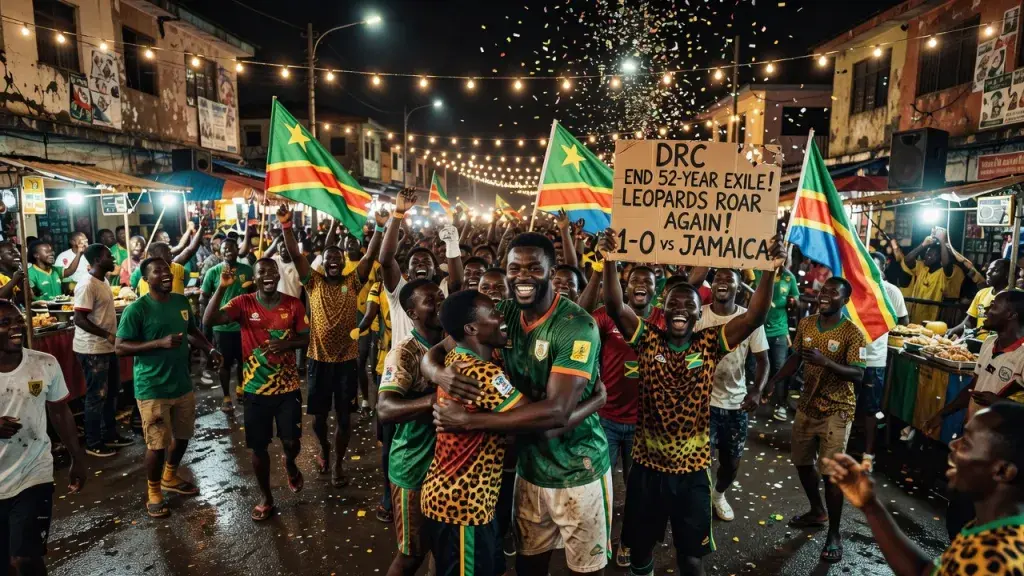
The Democratic Republic of Congo are returning to the World Cup for the first time since 1974, after a tense 1-0 extra-time victory over Jamaica in the FIFA Inter-confederation playoff secured their place at the 2026 tournament. The final whistle detonated celebrations across an entire nation - from the buvettes and ngandas of Kinshasa to the furthest reaches of the country - as the Leopards became Africa's tenth confirmed representative for next summer's expanded competition in the United States, Canada and Mexico.
The evening did not erupt all at once. Tension held Kinshasa in its grip for the duration of extra time, the confetti waiting, the city coiled. When the whistle finally came, it was heard on shortwave radios from Kananga to Kisangani, from Lubumbashi to Likasi, and the rumbas and ndombolos rang out through the streets in a carnival that had been building for five decades. The margin was the narrowest possible - one goal, 120 minutes - but no one in the DRC was measuring by margin. The result was everything. It is worth noting that this playoff drama unfolded across a very different competitive landscape to other football-adjacent betting markets like the futsal bookmakere scene, where formats are tighter and outcomes less laden with the weight of half a century of history.
The victory was about more than qualification. It was an opportunity for a nation long defined by one catastrophic tournament to begin rewriting a story that had been told, badly and unfairly, by everyone else.
The Ghost of West Germany, and What It Left Behind
Fifty-two years is a long time to live under someone else's caricature of you. For the DRC, that caricature has always been Zaire at the 1974 World Cup - specifically, Mwepu Ilunga sprinting from a defensive wall to hoof the ball clear before Brazil had even taken a freekick, Jairzinho and Roberto Rivelino watching on in bewilderment. The clip has been replayed so many times it has become detached entirely from its context, existing now only as farce.
But what preceded that tournament tells a sharply different story. Zaire, sub-Saharan Africa's first World Cup representatives, were Africa Cup of Nations champions in both 1968 and 1974. They produced players of genuine authority - the 'Black Beckenbauer' Tshimen Bwanga, goalkeeper Kazadi Mwamba, and Ndaye Mulamba, top scorer at the 1974 AFCON. Barring the great Ghana side of the 1960s, this was arguably the finest African national team assembled to that point. They were not a punchline; they were a continental power.
What undid them was not talent but politics. President Mobutu Sese Seko had weaponised the national team as an instrument of his doctrine of authenticité - a top-down project of nationalist identity construction designed to sever ties with Belgium and European influence. The team carried not just a country's hopes but a regime's demands. Preparation was chaotic, player bonuses went unpaid, and Mobutu's officials hovered over the camp with threats rather than support. When they arrived in West Germany, they were already broken. Scotland beat them 2-0 comfortably; Yugoslavia dismantled them 9-0 in Gelsenkirchen in what remains one of the heaviest defeats in World Cup history; and a 3-0 loss to Brazil, framed forever by the Ilunga incident, cemented the image.
The world simplified what was complex, and laughed at what was tragic. What followed was decades of decline - infrastructure decay, administrative dysfunction, a talent drain to Europe that was never properly replaced, and the steady erosion of a once-proud footballing identity. The fallen giants of African football settled into that role as though it were permanent.
Desabre's Outward Turn: A Different Kind of Nation-Building
Where Mobutu turned inwards in 1974, French head coach Sébastien Desabre has looked outward. His DRC squad is a study in diaspora football done right - players drawn from Belgium, France and Switzerland, some of whom speak Lingala fluently, others who have never set foot in Kinshasa. Some carry the weight of 1974 as a living inheritance; for others, it is a distant echo. Desabre's approach has been to treat that multiplicity as a strength rather than a complication.
The team that qualified on Tuesday night is ranked 46th in the world - hardly the position of a superpower - and their AFCON campaign this year, which reached the semifinals, showed flashes of promise without confirming dominance. The Jamaica win was a slog, not a statement of intent. But that, in itself, represents a form of maturity. In 1974, expectation distorted everything. Now, there is proportion.
It was fitting that the decisive contribution came from one of the diaspora. Axel Tuanzebe, the Burnley defender who was born in the DRC and raised in Rochdale after emigrating as a child, and who previously represented England at youth level, played his part in securing the ticket. A former England youth international, now a Leopard, he embodies precisely the kind of reconnection Desabre has built this squad around.
The Morning After the Long Night
There is a Lingala proverb that speaks to this moment with precision: 'Butu atako ewuneli suka tongo eko tana' - it doesn't matter how long the night is, the morning will always come. For fifty-two years, Congolese football fans have waited for that morning. On Tuesday, it arrived.
The injustice of 1974 was never simply the results. Nine goals conceded to Yugoslavia, three to Brazil - those are football facts. The injustice was the reduction of a sophisticated, genuinely accomplished African team to a single, distorted image; the erasure of what they had been before the tournament, and the indifference to why they collapsed within it. That story has clung to the DRC for more than half a century.
The 2026 World Cup will not automatically correct the record. One qualification does not undo five decades of accumulated misrepresentation. But it gives the Leopards a stage, and on that stage - in front of the world, in a tournament hosted across North America - they will have the chance to introduce themselves properly. Not as a symbol commanded from above, not as the hapless inheritors of an unfair joke, but as a nation reconnected: to its diaspora, to its continent, and to the game it once played so well.
In Kinshasa on Tuesday night, that felt like enough. The rumbas played until dawn.