
Wimbledon's 10-Point Tie-Break Rule Explained: How the Final Set Now Works
Authored by prc-ayxsports.net, 10-07-2026
Wimbledon has completed a transformation in how its matches are decided, replacing the old advantage-set format with a 10-point tie-break at 6-6 in the final set. The change, formally implemented at the 2022 Championships, ended the era of potentially open-ended deciding sets that once produced some of the most gruelling contests in tennis history. All four Grand Slams now share the same rule, bringing a long-overdue consistency to the sport's most prestigious events.
The shift is part of a broader effort across elite sport to modernise competition formats and protect both athlete welfare and spectator experience - a conversation happening in football and other disciplines too, as administrators worldwide continue to review the structure of their biggest events. Readers interested in how top-level sport governance decisions play out across competitions can find relevant context here. At Wimbledon specifically, the tie-break change was driven by the lessons of genuinely extreme matches that tested the limits of what players and scheduling could reasonably sustain.
How the 10-Point Tie-Break Actually Works
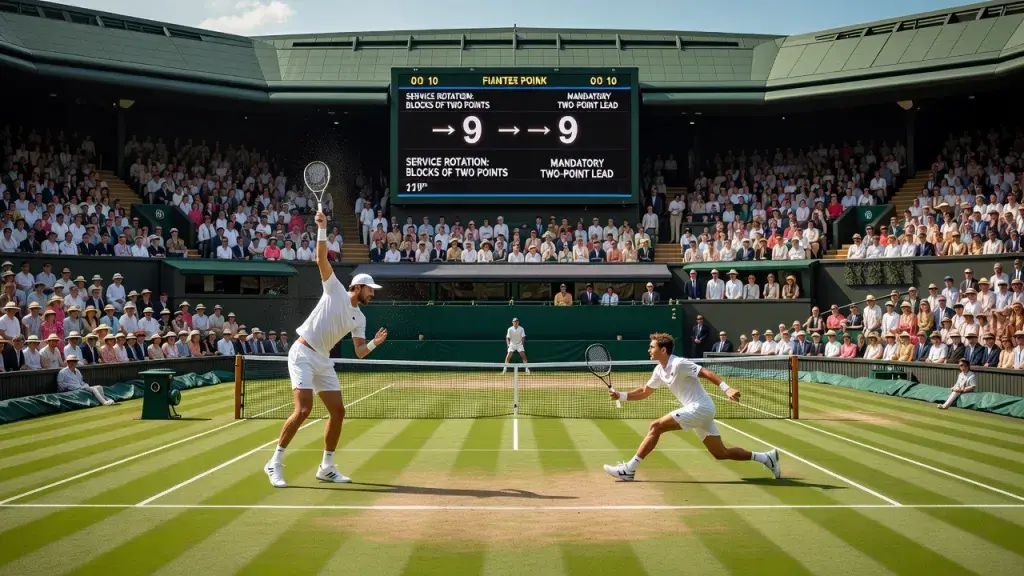
The mechanics of the 10-point tie-break mirror those of the traditional seven-point format, with one key difference: the winning threshold. One player serves for the first point, after which service alternates in blocks of two throughout the tie-break. The first player to reach 10 points wins - but they must hold at least a two-point lead over their opponent. If the score reaches 9-9, play continues until one player opens a two-point gap.
This format applies exclusively to the deciding set - the third set in women's singles and doubles, the fifth set in men's singles. All other sets that reach 6-6 are still settled by the conventional first-to-seven tie-break. The distinction matters: the longer format in the final set is designed to preserve drama and allow for momentum swings, rather than handing the match to whichever player holds serve on a single crucial point.
From Marathon Matches to a Manageable Finish
The rule change was a direct response to matches that had pushed well beyond the boundaries of reasonable competition. The most notorious example remains the 2010 Wimbledon first-round clash between John Isner and Nicolas Mahut, which stands as the longest match ever played at the All England Club and, by any measure, the longest in professional tennis history. The final set alone finished 70-68. The match had to be suspended overnight on two separate occasions and eventually concluded after 11 hours and five minutes spread across three days.
The toll on Isner was visible immediately. In his very next match, he was beaten in just over an hour, later admitting he had nothing left physically or mentally. "I've never been this exhausted before," he said. "Mentally and physically, I was obviously a bit drained. I just didn't have much in the way of my legs. I was just low on fuel out there." Isner himself was involved in the second-longest Grand Slam match at Wimbledon 2018, losing 26-24 in the final set to Kevin Anderson - proof that the problem was structural, not a one-off quirk.
Wimbledon had already taken an intermediate step before the current rule, introducing a conventional tie-break at 12-12 in the final set. That produced its own memorable moment: Novak Djokovic defeating Roger Federer 13-12 in the fifth set of the 2019 final, one of the most gripping matches the tournament has ever staged. But the Grand Slam board concluded that a uniform standard across all four majors was necessary, and in March 2022 announced the move to the 10-point format across every Slam.
The Grand Slams Fall Into Line
The Australian Open had already led the way, adopting the 10-point tie-break in the deciding set back in 2019. Tournament director Craig Tiley was clear about the reasoning at the time: "We went with a 10-point tie-break at six-all in the final set to ensure fans still get a special finale to these contests, with the longer tie-break allowing for that one final twist or change of momentum in the contest. This longer tie-break also can lessen some of the serving dominance that can prevail in the shorter tie-break."
The first Wimbledon match played under the new rule carried a notable storyline. Serena Williams, making her return to Grand Slam tennis after a year away, faced French qualifier Harmony Tan in the first round in 2022. The match went to the final-set tie-break, where Tan prevailed to eliminate the 23-time Grand Slam champion in what became one of the most surprising first-round results in the tournament's recent history. The new rule had arrived, fittingly, in a match that would have been talked about regardless of format.
The Grand Slam board's statement framing the decision was straightforward: consistency and a better experience for players and fans. After decades of rules that varied between majors and produced occasional outliers that belonged more to endurance sport than tennis, the governing bodies had converged on a solution. The 10-point tie-break will not eliminate drama at Wimbledon - if anything, it concentrates it into a high-stakes sprint when the deciding set has gone all the way to the wire.