
Czech Women Reshape Wimbledon Again, With Nosková and Muchová in the Semis
Authored by prc-ayxsports.net, 09-07-2026
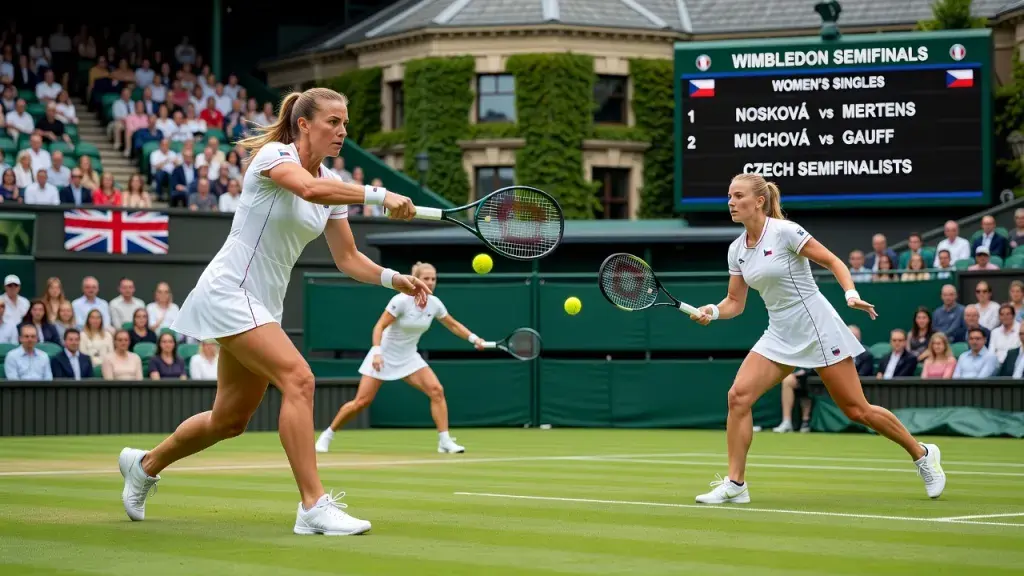
THE ALL ENGLAND CLUB, London - Half of the women's semifinalists at this year's Wimbledon carry Czech passports. Linda Nosková, 21, and Karolína Muchová, 29, are through to the last four at the All England Club, extending one of the most remarkable national traditions in the history of women's tennis. A country of 11 million people has once again arrived at the sport's most prestigious stage in numbers that no nation of comparable size can match.
Nosková booked her place with a commanding 6-3, 7-5 quarterfinal victory over No. 25 seed Elise Mertens - a result more one-sided than the scoreline implies - while Muchová advances to face Coco Gauff in the first semifinal, armed with an all-court game that veteran observers have compared in texture and ingenuity to Roger Federer's. The pair represent the newest chapter of a lineage that, for anyone trying to understand women's tennis globally, demands proper study. Much like the emerging generation of young women's footballers whose transfer market has exploded - the lisa baum arsenal transfer story is a useful parallel for how nations produce prodigies who redefine what is possible at a young age - the Czech Republic has built a conveyor belt that confounds easy explanation.
The lineage begins, as so much in women's tennis does, with Martina Navratilova. She won nine Wimbledon singles titles, seven women's doubles and four mixed doubles - numbers that remain untouched. She defected from Czechoslovakia to the United States in 1975, but the girls she left behind kept watching. That watching became emulating. Navratilova's successors include Hana Mandlíková, Helena Suková, Jana Novotná, Petra Kvitová, Karolína Plíšková, Barbora Krejčíková, Markéta Vondroušová and Kateřina Siniaková. All of them won Grand Slam titles or reached world No. 1. The majority won the Wimbledon singles title. Krejčíková, the defending champion here two years ago, beat Nikola Bartůňková in the third round before Muchová eliminated her in the fourth - Czechs ending each other's runs before the quarterfinals even arrived.
A Legacy Held Lightly
What is striking about Nosková and Muchová is not that they revere this tradition, but that they came to it almost by accident. Neither grew up steeped in Czech tennis lore. Muchová was barely a tennis fan as a child. Her father and brother were both professional footballers; sport was everywhere in her household, but it was not directed. "I think I figured out what a Grand Slam is when I was a teenager," she said in a press conference this week. When she eventually achieved enough success to make the history relevant, she had to go looking for it herself. "I looked back on all the great results from our Czech legends," Muchová said. "It's honestly crazy how many Czech girls were able to win here."
Nosková's story runs parallel. She grew up with gymnastics, horse riding and half a dozen other pursuits competing for her attention. Tennis was simply one option among many. "It was never mainly tennis," she said after beating Mertens. The contrast with the dominant model of elite youth development - early specialisation, structured academies, home-schooling built around one sport - could hardly be sharper. Yet the results speak loudly enough to constitute a rebuke to that model, or at least a challenge to its assumptions.
How the Czech System Actually Works
Navratilova, in a recent interview, offered the clearest articulation of what makes Czech development different. She contrasted it with the Florida model she has observed in the United States - hours of drills, feeding balls from shopping carts, rehearsing technique in isolation. In the Czech Republic, she said, children play points and games and sets from the start. They learn to construct rallies, to read opponents, to manage the rhythm of a match as it shifts. They do it on clay, which demands patience, footwork and tactical variety. The result is players who arrive at the professional level with full shotmaking arsenals and the competitive instincts that come from years of actually competing.
Krejčíková, reflecting on her own development, described a club environment rich with matches, team events, singles and doubles played every weekend. The knowledge chain stays intact too. Krejčíková wrote Jana Novotná a letter at 18; Novotná became her coach. Nosková, who knew Kvitová - the two-time Wimbledon champion who retired in 2025 - mostly from magazine covers and billboards, found herself on the other side of the net from her at 18, then learned to navigate grass for the first time in Nottingham alongside Barbora Strýcová. "I was so lost," Nosková said. "She had all these great results on grass. It was tough to kind of match her rhythm." That she was even in that environment, absorbing from a former world No. 1 in doubles, tells you a great deal about how the system perpetuates itself.
What Nosková and Muchová Actually Do on a Tennis Court
Against Mertens on Wednesday, Nosková was a study in the all-court vocabulary that Czech coaching nurtures. She drove backhands deep to move her opponent, then won points with backhand drop volleys and slice backhands that died flat on the grass near the sideline. She floated chip returns to pin Mertens at the baseline before feathering drop shots barely over the net cord. She also served aggressively, firing aces and unreturned deliveries throughout. The variety was not decorative - it was functional, a toolkit deployed with the judgment of someone who learned to think through points rather than simply strike balls. Muchová's approach against Gauff will be similarly layered. Her coaches, she noted, never told her that unconventional shots would not work. "We were working on my slice and all that," she said, "even though when I was a kid, it wasn't working that much." The point is that they kept working on it.
On Thursday, Nosková steps on court as the youngest first-time major semifinalist at Wimbledon since 2010. That year, the player who held the distinction was Petra Kvitová. The line from Navratilova runs unbroken, even if the newest names in it barely knew it existed when they were growing up.