
Jay-Jay Okocha Redefined African Football and Made the World Watch
Authored by prc-ayxsports.net, 18-06-2026
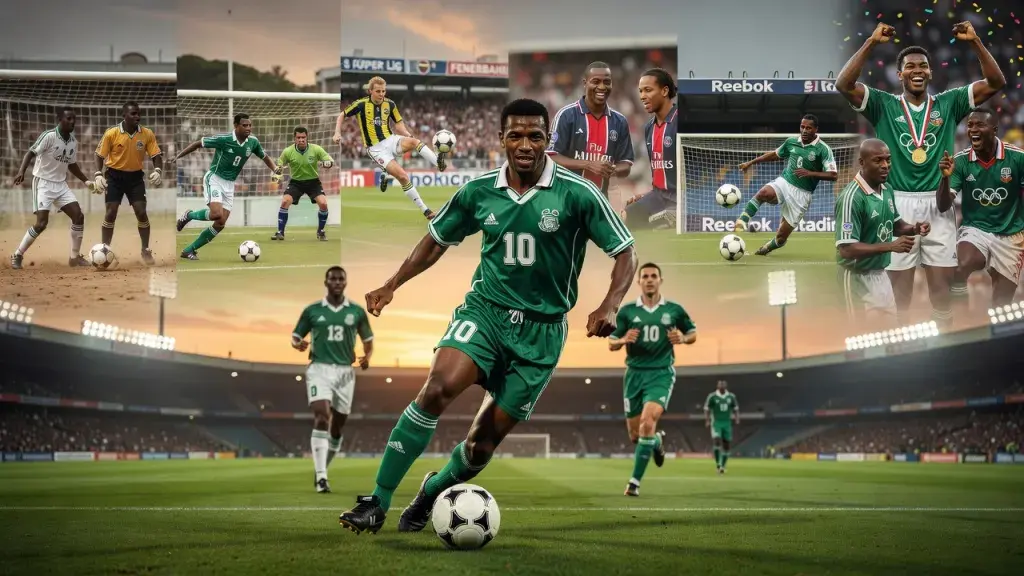
Nigeria has gifted the world a remarkable lineage of footballers - from the pioneering Segun Odegbami and the lethal Rashidi Yekini to the tenacious Sunday Oliseh and the modern-day menace Victor Osimhen. Yet across generations of Nigerian football, one name rises above the rest with an almost unanimous verdict: Austin "Jay-Jay" Okocha, the attacking midfielder whose artistry on the ball turned stadiums into theatres and made football feel like something close to magic. Born on August 14, 1973, in Enugu, in Nigeria's Eastern region, Okocha did not merely play the game - he reimagined it.
What separated Okocha from his peers was not just his dribbling, his range of passing, or his venomous shooting - it was the sheer audacity with which he deployed all of those qualities at the same time, often in moments of the highest pressure. His career arc, stretching from the domestic pitches of Nigeria to the grand arenas of the Bundesliga, Ligue 1, and the Premier League, remains one of the most compelling journeys in African football history. The sport he played is a world away from niche disciplines where fans today browse futsal odds online in search of fast-paced indoor excitement, yet the flair and improvisation that define futsal at its finest were qualities Okocha brought to the full-sized pitch every single week.
The Name Behind the Legend
The nickname "Jay-Jay" carries its own story. It was originally borne by his elder brother, James Okocha, who played football before Austin did. Another brother, Emmanuel, was also known as Emma Jay-Jay for a time. But as Austin's talent grew and his reputation spread, the name transferred to him with a permanence that no one disputed. It became so synonymous with him that Bolton Wanderers, during his time in the Premier League, printed shirts bearing the phrase: "Jay-Jay - so good they named him twice." That slogan, charming in its simplicity, captured something genuine about how football fans received him.
From Enugu to the Bundesliga: The Making of a Maestro
Okocha's first senior club was Enugu Rangers, whom he joined in 1990 and immediately caught the eye with performances that went beyond the ordinary. A memorable moment during his time there saw him round goalkeeper Willy Okpara of BCC Lions of Gboko in spectacular fashion before finishing - an early glimpse of the player he would become. Later that same year, a holiday trip to West Germany, the country that had just lifted the FIFA World Cup, changed everything. His friend Binebi Numa was playing for Borussia Neunkirchen in the third division, and Okocha tagged along to a training session out of curiosity. The coach, sufficiently impressed to invite him back the following day, eventually offered him a contract. From Neunkirchen, Okocha moved briefly to 1. FC Saarbrücken in the 2. Bundesliga before landing at Eintracht Frankfurt in December 1991, where his career genuinely took flight.
At Frankfurt, he shared a dressing room with Ghanaian striker Tony Yeboah and Thomas Doll, operating in an environment that demanded quality. He delivered it, most memorably with a goal against Karlsruher SC that entered football folklore: weaving through the penalty area, going past defenders twice, before rolling the ball past a young Oliver Kahn. The effort was voted the 1993 Goal of the Year by viewers of Sportschau and earned plaudits across the German football press. He scored 18 goals in 90 Bundesliga appearances - a solid return for an attacking midfielder operating in one of Europe's most competitive leagues at the time.
Istanbul, Paris, and the Peak Years
When Eintracht Frankfurt were relegated from the Bundesliga, Okocha followed the opportunity to Fenerbahçe in Turkey's Süper Lig for £1 million. He thrived there, netting 30 goals in 62 appearances across two seasons, with his direct free kicks becoming a signature weapon that supporters came to anticipate with relish. His reputation was growing across Europe, and in 1998, Paris Saint-Germain paid a fee reported at around £14 million to bring him to Ligue 1 - a sum that made him the most expensive African footballer in the world at that point. It was a statement of intent from PSG and a validation of everything Okocha had built over the preceding decade. During four years in Paris, he made 84 appearances and scored 12 goals, but his influence stretched beyond statistics. A young Brazilian midfielder named Ronaldinho arrived at the club and found in Okocha a mentor - a detail that, in retrospect, feels both fitting and historically significant given the heights Ronaldinho would later reach. Okocha also contributed five goals in the 2001 UEFA Intertoto Cup, helping PSG claim joint honours alongside Aston Villa and Troyes.
Bolton, the Super Eagles, and a Legacy That Endures
His move to Bolton Wanderers in the summer of 2002, on a free transfer, brought Okocha to England and introduced him to a new audience. In his first season, injuries slowed him, yet he still managed to produce enough moments of brilliance - including a Goal of the Season winner against West Ham United that was later voted Bolton's finest-ever Premier League goal in a 2008 fan poll - to keep the club from relegation. The following season brought greater responsibility: with Guðni Bergsson retiring, Okocha was handed the captaincy and led Bolton to the 2004 Football League Cup final, their first cup final in nine years. They lost to Middlesbrough, but the achievement underlined Okocha's stature within the club. After Bolton, a stint in Qatar followed before a final return to English football with Hull City in 2007, though persistent injury problems limited his contribution to 18 appearances, none of them resulting in goals. Hull earned promotion to the Premier League for the first time in their 104-year history without Okocha being able to shape that journey, and he was released at the end of the season.
On the international stage, Okocha was the central figure for the Super Eagles across the best years of Nigerian football. He was part of the squad that won the 1994 Africa Cup of Nations in Tunisia and featured as Nigeria made their World Cup debut in the United States that same year, reaching the knockout rounds. Two years later came his crowning international moment: the 1996 Olympic Games in Atlanta, where Nigeria defeated Argentina in the semi-finals before claiming gold against a formidable field - a result that sent shockwaves through world football and announced Africa's ambitions with unmistakable clarity. Okocha was at the heart of it. He remains, more than two decades after his peak, the benchmark against which Nigerian creative midfielders are measured - a player who made football beautiful not as an accident of talent, but as a deliberate and joyful act of expression.