
Walker Zimmerman Details Why USMNT Is Shifting to a Back Three for 2026
Authored by prc-ayxsports.net, 12-06-2026
Walker Zimmerman Details Why USMNT Is Shifting to a Back Three for 2026
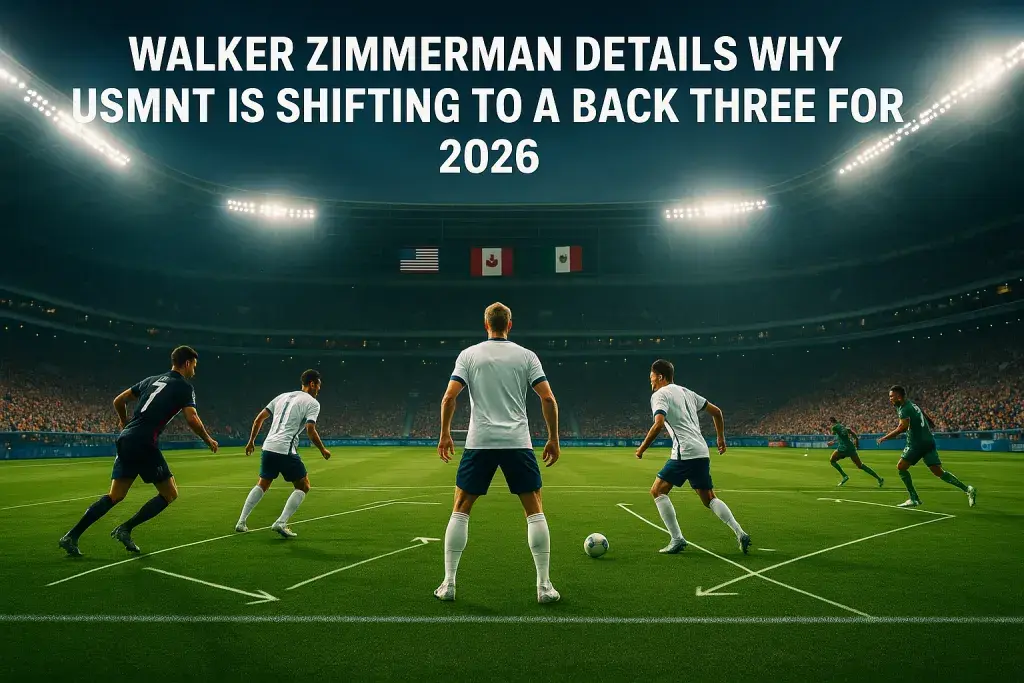
The United States men's national team is expected to open the 2026 FIFA World Cup in a back-three defensive shape - a tactical departure from the back-four system used at the 2022 tournament in Qatar. A player who featured at that World Cup has broken down the reasoning behind the shift, pointing to personnel, opponent matchups, and the specific demands the formation places on individual players.
Central to the decision is the role of wing-backs Antonee Robinson and Sergiño Dest. Robinson, who plays at left back for Fulham in the Premier League, offers the engine and range to push forward aggressively while remaining capable of tracking back in transition. Dest, a right-sided defender, is described as most effective when allowed to operate higher up the pitch, with the expectation that he will contribute to attacks before recovering defensively when required. The system rewards those traits in a way a traditional back four does not.
Veteran center back Tim Ream, 38, is also a factor in the formation choice. The team captain started on the left side of the back three in pre-tournament friendlies against Senegal and Germany. Playing him in a three-center-back structure provides additional cover in wide areas, reducing his exposure in one-on-one situations against quick wingers - a vulnerability highlighted when Germany's Leroy Sané isolated him during the Germany friendly. The Senegal match, played on May 31, illustrated the risks of the system as well: Robinson losing possession high up the field left Ream exposed, and the resulting counter ended with Sadio Mané scoring.
The back-three shape also functions as a back five when the team drops into a low defensive block under sustained opposition pressure - a flexibility that can be tactically useful but demands disciplined positional awareness from every player involved. By contrast, the back four used at the 2022 World Cup was built around a high-functioning three-man midfield of Tyler Adams, Weston McKennie, and Yunus Musah, whose collective work rate and range allowed them to cover ground typically requiring a fourth midfielder. That engine allowed the U.S. to maintain structural compactness across the pitch, as demonstrated in the opening group-stage match against England. Adams, who remains central to the midfield setup, provides a similar defensive security blanket in the current system - his ability to win the ball and suppress counterattacks giving the back three greater license to engage higher up the field when in possession.
With the 2026 World Cup set to be hosted across the United States, Canada, and Mexico, the USMNT enters the tournament as a co-host nation for the first time. The formation the team deploys from the outset will be shaped by the opponent and available personnel, with the back three representing the expected starting point rather than a fixed commitment across all matches.